
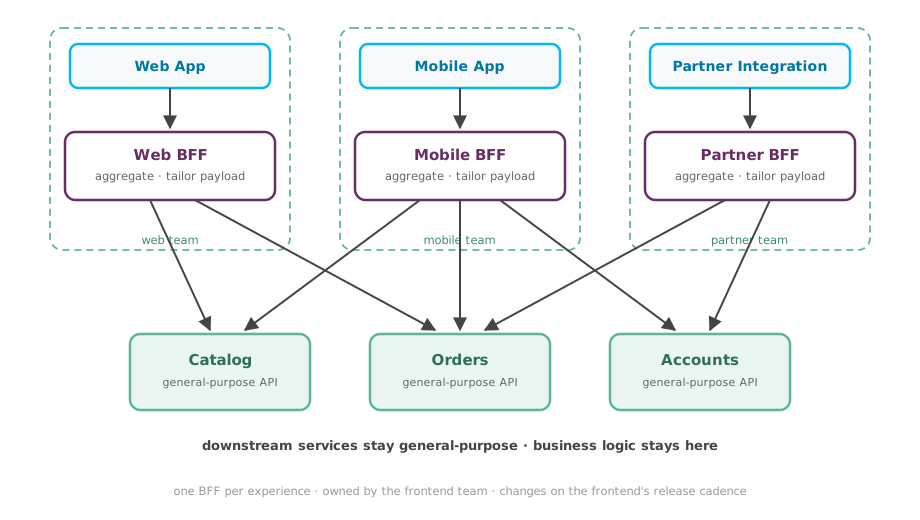
Backends for Frontends gives each user experience — web, mobile, partner integration — its own dedicated backend instead of routing every client through one general-purpose API. Each BFF aggregates downstream services and shapes responses for exactly one frontend, and the team building that frontend owns it.
The pattern trades deliberate duplication for independent evolution: each experience changes its contract at its own pace; the general-purpose API stops being where every client’s needs collide. SoundCloud, where the pattern was named, ran dozens of BFFs.
How It Works
- One BFF per user experience, not per platform vendor; experiences with near-identical needs share one.
- The frontend team owns its BFF end to end: contract, aggregation logic, payload shape, release cadence.
- The BFF fans out to downstream services and combines their responses into one payload — typically one call per screen.
- Business rules stay downstream; the BFF holds only experience-specific aggregation, mapping, and edge concerns.
Failure Modes
- The BFF accretes business logic and becomes a thin monolith per client; domain rules now live in several client-specific copies that disagree.
- BFFs multiply unchecked — one per device model or sub-team — leaving dozens of near-identical services nobody consolidates.
- Edge concerns reimplemented per BFF drift: one client receives a security fix while the others keep the hole.
- A BFF fans out synchronously to many slow services; the aggregation hop becomes the dominant latency and availability bottleneck.
Verification
- Network traces show one BFF round trip per screen or view at the 95th percentile.
- Deployment logs show BFF releases riding the frontend’s cadence, with no coordinated downstream releases.
- A change-coupling report shows business-rule changes landing in downstream services only; recurring BFF edits for policy changes flag logic leakage.
Variants and Related Tactics
- An API gateway is the single-front-door alternative; thin per-client gateway configurations blur into BFFs.
- GraphQL on one shared endpoint lets clients shape responses themselves — an alternative when payload flexibility, not team ownership, is the goal.
- Micro frontends extend the same per-experience ownership into the UI.
References
- Backends For Frontends — Sam Newman (2015)
- The Back-end for Front-end Pattern (BFF) — Phil Calçado (2015)
- Building Microservices, 2nd ed. — Sam Newman (O’Reilly, 2021)