
Event-driven architecture connects components through events: immutable records that something happened — an order placed, a payment captured. Producers publish to a broker and move on; consumers subscribe and react independently. Where asynchronous messaging moves work off the request path, this style defines the system’s topology by subscriptions: the tenth consumer attaches exactly like the first.
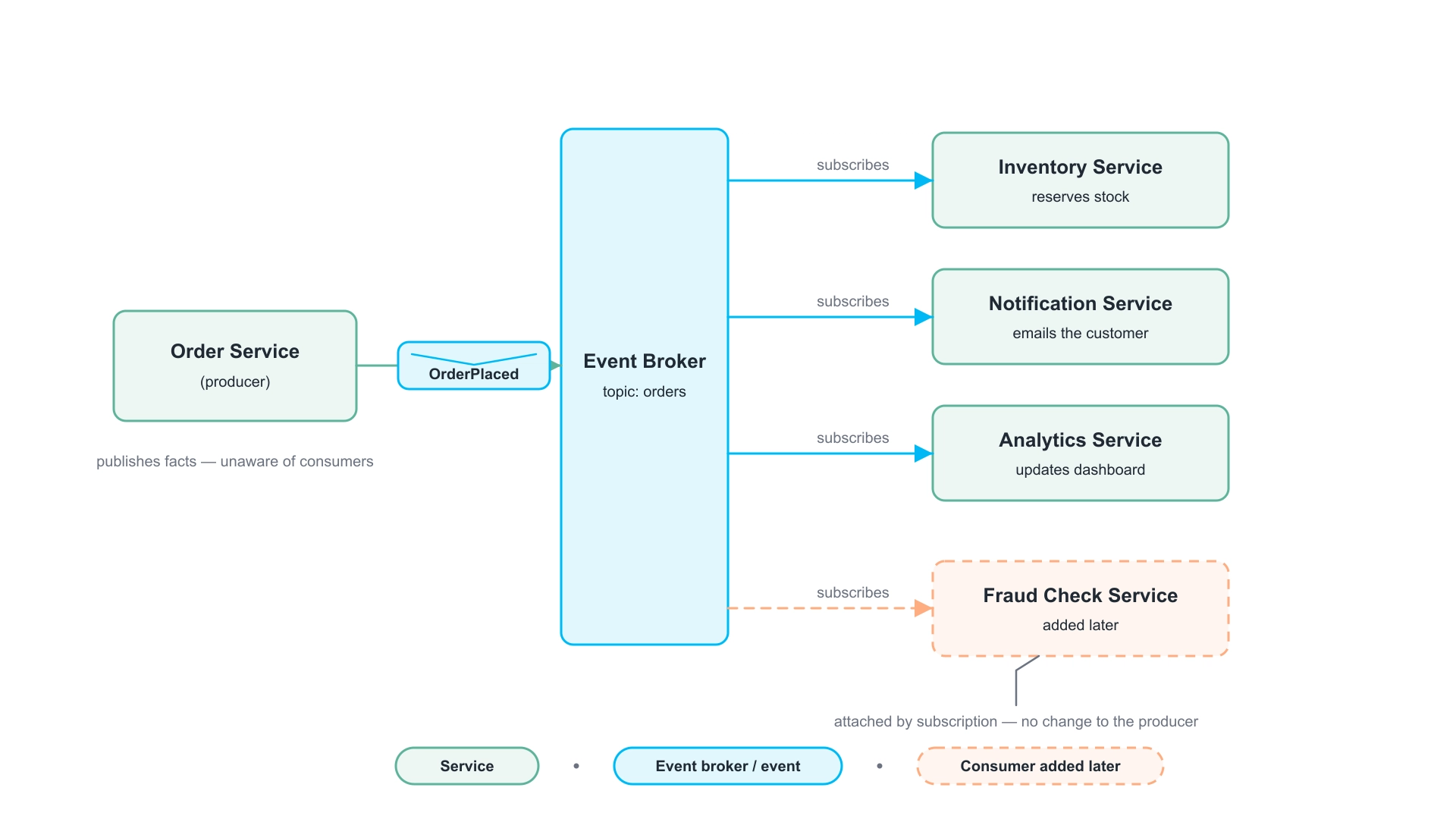
The diagram shows the fan-out of one event type; in a running system, consumers often publish further events of their own, forming chains.
How It Works
- A component completes a local state change, then publishes an event naming the fact in past tense (
OrderPlaced) to a broker topic. - The broker delivers the event to every subscriber; each consumer runs its own logic — update a projection, notify a user, start a follow-on process — and may publish further events.
- Event notification carries only a reference, and consumers call back for details; event-carried state transfer embeds the data.
- The event schema is the public contract. Producers evolve it backward-compatibly, because they cannot enumerate their consumers.
Failure Modes
- A “minor” schema change breaks consumers the producing team never knew existed — the schema is the coupling surface.
- A consumer emits an event that re-triggers the original producer; the feedback loop floods the broker (event storm).
- At-least-once delivery duplicates events; consumers without idempotent handlers double-charge or double-notify.
- A silently failing subscriber falls behind; growing lag turns bounded staleness into unbounded drift.
Verification
- Consumer-driven contract tests run every subscriber’s expectations against the producer’s schema in CI; a breaking change fails the producer’s build.
- Replaying redelivered events against each consumer produces side effects exactly once.
- Consumer lag per subscription stays under its threshold; an alert fires on the age of the oldest unprocessed event.
- CI diffs a generated subscription map (who consumes which event) against live broker configuration.
Variants and Related Tactics
- Asynchronous messaging provides the transport beneath the style — queues, retries, dead-letter handling.
- CQRS projects events into read-optimized views.
- Choreography-style sagas coordinate distributed transactions purely through events, adding compensation on failure.
- Event sourcing is the persistence-side counterpart: within one component, the event log is the system of record and current state derives from replay — a decision independent of how components communicate.
References
- What do you mean by “Event-Driven”? — Martin Fowler
- Enterprise Integration Patterns — Gregor Hohpe & Bobby Woolf (full citation)
- Building Event-Driven Microservices — Adam Bellemare, O’Reilly, 2020