
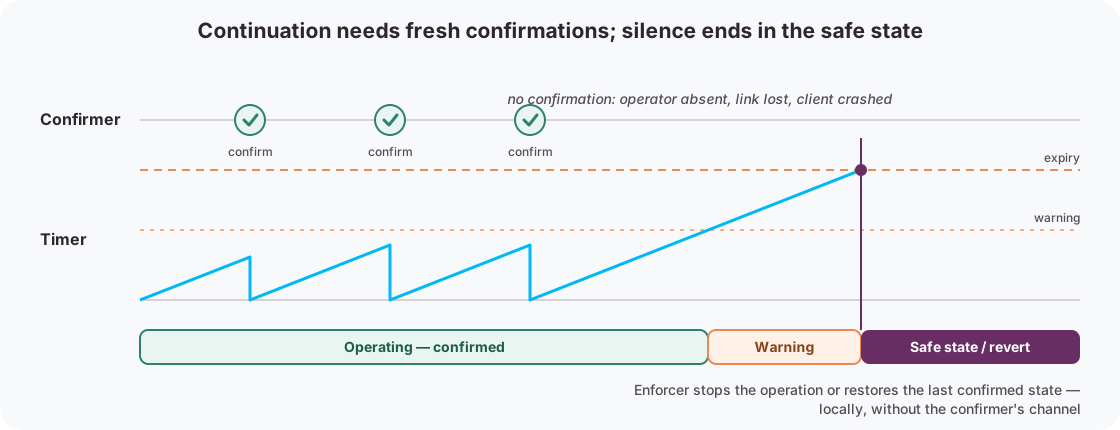
A dead man’s switch keeps a hazardous operation or a risky change in force only while a responsible party keeps confirming it. Each confirmation arms a timer; on expiry the system stops or reverts to the last confirmed state. Silence, incapacity, a crashed client, and a lost connection all end safe.
It reverses the burden of proof of Watchdog Supervision: a watchdog continues until it detects a failure; a dead man’s switch stops unless someone vouches for continuation. The confirmer is the party accountable for the operation — driver, machine operator, engineer applying a remote change — not the component doing the work.
How It Works
- Define the fallback per operation: stop the motion, cut the drive, or restore the previous configuration.
- Size the interval to how long the hazard may run unattended — seconds for machinery, minutes for a remote change.
- Make each confirmation a deliberate act an absent person cannot produce: a pedal, a button, a confirm command.
- Warn before expiry, so attentive operators confirm in time.
- An independent enforcer executes the fallback locally — brake controller, safety relay, configuration daemon.
- Remote changes apply provisionally with a scheduled rollback and commit only on explicit confirmation.
Failure Modes
- Operators defeat the switch — a weight on the pedal, a confirming script — and the operation runs unattended.
- Confirmation becomes a reflex, proving presence, not attention.
- Intervals too short for the task cause nuisance stops, which invite bypasses.
- Fallback and confirmation share one channel, so a lost link leaves an unconfirmed change in force.
- The fallback is unsafe in context, e.g. a rollback reverting a security fix.
- A startled operator clamps the control instead of releasing it.
Verification
- Lapse test: withhold confirmation; the fallback completes within interval + warning + actuation tolerance (e.g.
30 s + 5 s + 1 s). - Channel-loss test: drop the confirmer’s session mid-change; the enforcer still reverts locally.
- Revert fidelity: after expiry, the running configuration equals the last confirmed one.
- Defeat check: zero sessions with machine-regular confirmation timing.
- Nuisance-stop rate below an agreed threshold (e.g.
< 1per 100 operating hours).
Variants and Related Tactics
- Rail vigilance control: a missed acknowledgement triggers a warning, then the emergency brake.
- Three-position enabling switches stop on release and on full squeeze, countering the panic grip.
- Confirmed commit (RFC 6241) rolls back remote changes that cut off the operator.
- Trial boot: new firmware confirms its own health, or the bootloader falls back to the previous image.
- Leases apply the same expiry to machine authority (locks, leadership) — a distributed-coordination tactic.
References
- RFC 6241: Network Configuration Protocol (NETCONF), §8.4 Confirmed Commit Capability — R. Enns, M. Bjorklund, J. Schoenwaelder, A. Bierman (2011)
- Ironies of Automation — Lisanne Bainbridge, Automatica 19(6) (1983)
- IEC 60947-5-8: Low-voltage switchgear and controlgear — Three-position enabling switches
- IEC 61508 — functional safety of electrical/electronic/programmable electronic safety-related systems