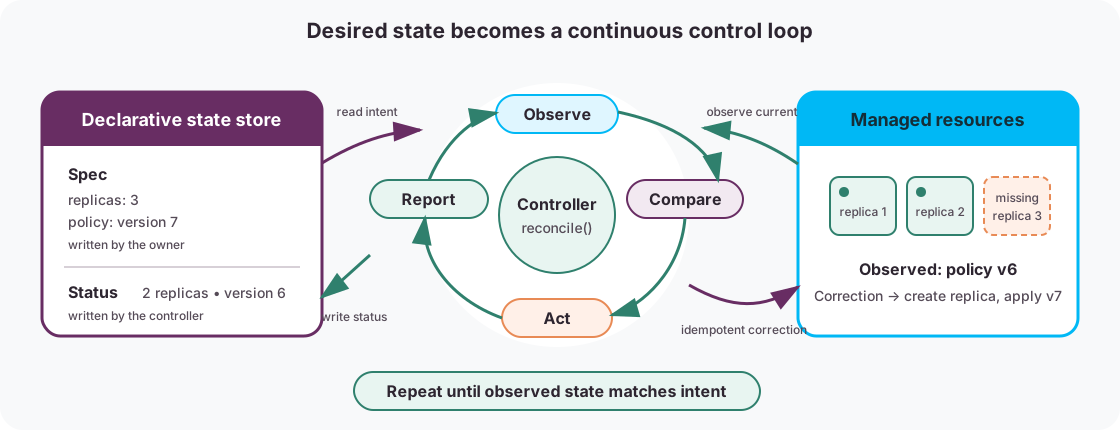
Imperative automation runs a sequence once. A reconciliation loop keeps asking: what differs between declared intent and reality now? It then makes one correction and asks again.
Because the loop is level-triggered, correctness depends on current state rather than seeing every event. After a restart, a missed notification, or a half-completed action, remaining state becomes the next input to the loop—not a special recovery path.
How It Works
- Store desired state durably and keep controller-written status separate from owner-written intent.
- Reconcile on change notifications and periodic resynchronization, so a missed event delays correction but cannot lose it permanently.
- Compute the smallest correction from current state; make it idempotent.
- Assign each field or resource to one controller.
- Report conditions and retry with bounded backoff until reality matches intent.
Failure Modes
- Two controllers own the same field and overwrite each other; the resource oscillates and both loops consume their retry budgets.
- A stale observation triggers a correction against superseded state; newer intent is temporarily rolled back.
- An edge-triggered controller misses an event and never revisits the resource, leaving permanent drift.
- Invalid or unreachable desired state causes unbounded retry attempts at maximum backoff, saturating control-plane capacity while status stays unready.
Verification
- Replica-controller convergence SLO: with target
N, deleting one instance returns the observed count toNwithin60 s. - Idempotency check: reconciling an already-converged resource twice produces zero external writes and no status change.
- Crash check: stop the controller after its first side effect; after restart it converges without duplicate resources or skipped steps.
- Steady-state signal: failed reconciliations stay below
1%per 15-minute window; every failure exposes a reason and next retry time.
Variants and Related Tactics
- The MAPE-K loop separates monitoring, analysis, planning, and execution when adaptation needs richer decisions than a direct state diff.
- GitOps uses a version-controlled declaration as desired state and a reconciliation loop as its enforcement mechanism.
- A watchdog checks liveness and usually restarts. A reconciler checks full state and can create, update, delete, or repair resources.
References
- The Vision of Autonomic Computing — Jeffrey O. Kephart and David M. Chess (2003)
- Borg, Omega, and Kubernetes — Brendan Burns et al. (2016)
- Anvil: Verifying Liveness of Cluster Management Controllers — Xudong Sun et al. (OSDI 2024)